Sustainable living starts with the choices we make at home. From the amount of water we use to the products we buy, everyday decisions have an impact on the environment.
Fortunately, adopting eco-friendly habits for Indian households does not require expensive products or major lifestyle changes. Small and consistent actions can reduce household waste, conserve water, save energy, and encourage responsible consumption.
Many traditional Indian practices already support sustainable living. Reusing containers, carrying cloth bags, repairing household items, buying local products, and avoiding food waste are good examples.
By combining these practices with modern sustainability ideas, families can build greener homes without making life complicated.
In this guide, we explore practical eco-friendly habits that Indian families can follow every day.
What Does an Eco-Friendly Household Mean?
An eco-friendly household tries to reduce its environmental impact through responsible everyday choices.
This can include conserving water and electricity, reducing waste, avoiding unnecessary plastic, reusing products, composting organic waste, and choosing durable alternatives.
However, sustainable living is not about being perfect.
Instead, it is about making better choices whenever they are practical.
For example, carrying a reusable shopping bag may seem like a small action. However, when it becomes a regular habit across many households, it can help reduce dependence on disposable bags.
Why Should Indian Households Adopt Eco-Friendly Habits?
India’s growing population and consumption create increasing demand for water, energy, food, packaging, and other resources.
Households can play an important role in using these resources responsibly.
Simple sustainable practices can help families:
- Reduce household waste
- Minimise single-use plastic
- Conserve water
- Reduce unnecessary electricity use
- Prevent food waste
- Encourage reuse and repair
- Support local communities
- Teach children environmental responsibility
Some sustainable habits can also help reduce household expenses.
Therefore, an eco-friendly lifestyle can benefit both families and the environment.
1. Reduce Single-Use Plastic
Reducing disposable plastic is one of the most practical eco-friendly habits for Indian households.
Plastic bags, cups, straws, plates, bottles, and cutlery may be convenient. However, many are designed to be discarded after a short period of use.
Start by identifying the disposable products your family uses regularly. Then, look for reusable alternatives where practical.
For example:
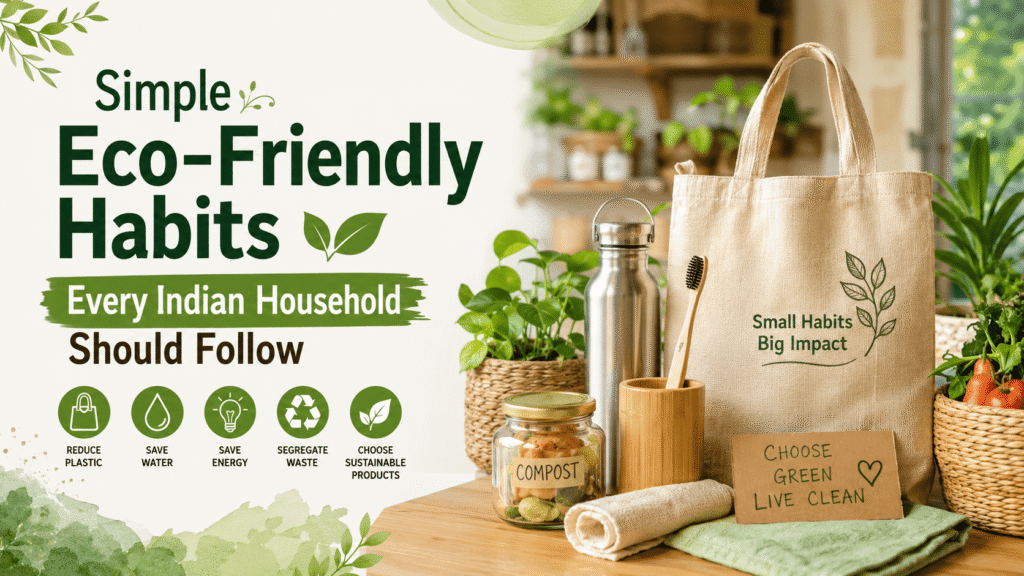
- Carry cotton or jute shopping bags
- Use reusable water bottles
- Carry reusable lunch boxes
- Choose reusable cups
- Use durable kitchen containers
- Carry reusable cutlery when necessary
Most importantly, do not throw away usable products simply to replace them with an eco-friendly version. Continue using what you already own until it reaches the end of its useful life.
2. Carry Reusable Bags While Shopping
One of the easiest sustainable habits is carrying your own shopping bag.
Keep reusable bags in places where they are easy to remember. For example, keep one near your front door, inside your vehicle, or with your regular shopping items.
Cotton bags, jute bags, and traditional palm-leaf baskets can be useful alternatives for carrying groceries, vegetables, and other items.
This habit is simple, affordable, and easy for most families to adopt.
3. Segregate Waste at Home
Responsible waste management begins before waste leaves your home.
Instead of placing everything into one bin, separate waste according to your local waste collection guidelines.
Common household waste categories may include:
- Organic or wet waste
- Dry waste
- Paper and cardboard
- Plastic
- Glass
- Metal
- Sanitary waste
- Hazardous household waste
Waste segregation helps keep recyclable materials separate from food and other contaminants.
It can also make composting and recycling more effective.
Check your local municipal guidelines because collection and segregation requirements can vary between locations.
4. Compost Suitable Kitchen Waste
Vegetable peels, fruit scraps, tea leaves, and other suitable organic materials can often be composted.
Instead of sending all kitchen waste to general waste collection, households can consider creating a small composting system.
Depending on available space, composting can be done on a balcony, terrace, garden, backyard, or another suitable ventilated area.
The finished compost can support balcony plants, flower pots, terrace gardens, and kitchen gardens.
Composting therefore helps turn suitable organic waste into a useful resource.
5. Reduce Food Waste
Food requires water, energy, labour, transportation, and money to produce and deliver.
Therefore, preventing food waste is an important part of sustainable living.
Before shopping, check your kitchen and prepare a list. Buy quantities that your family is likely to consume.
Store food correctly to maintain freshness. In addition, safely stored leftovers can sometimes be used in another meal.
A simple weekly meal plan can also help families avoid unnecessary purchases.
Reducing food waste is good for the environment and household budgets.
6. Conserve Water Every Day
Water conservation should become part of every household routine.
Fortunately, families can start with very simple actions.
Turn off taps while brushing your teeth. Repair leaking taps and pipes quickly. Avoid leaving water running unnecessarily while washing dishes or cleaning.
Also, use only the amount of water required for each task.
Where practical, rainwater harvesting can provide another way to improve water management at home.
Small savings repeated every day can add up over time.
7. Save Electricity at Home
Reducing unnecessary electricity consumption is another important sustainable habit.
Switch off lights, fans, televisions, and other electrical devices when they are not required.
Also, unplug chargers when they are no longer being used.
During the daytime, make better use of natural light where possible.
When replacing appliances, families can consider energy-efficient models that meet relevant energy-efficiency standards.
Solar energy may also be worth considering for households where it is practical and affordable.
8. Use Natural Light and Ventilation
Many Indian homes receive strong natural light for several hours each day.
Make use of it when possible.
Open curtains and windows instead of automatically switching on lights during the daytime.
Natural ventilation may also help keep indoor spaces comfortable when weather conditions and outdoor air quality are suitable.
This reduces unnecessary dependence on artificial lighting and cooling.
9. Choose Reusable and Sustainable Products
Our purchasing decisions influence how much waste we generate.
Therefore, choose products designed for repeated use whenever they are practical.
Examples can include:
- Reusable cotton bags
- Bamboo toothbrushes
- Bamboo combs
- Reusable bottles
- Palm-leaf baskets
- Natural storage products
- Reusable kitchen products
- Plantable stationery
However, sustainability is not about constantly buying new “green” products.
A better approach is to use existing items for as long as possible. When replacement becomes necessary, consider a durable and reusable alternative.
10. Reuse Household Items
Many everyday items can be used more than once.
Glass jars can become storage containers. Cardboard boxes can help organise household items. Old clothes can become cleaning cloths.
Gift bags and suitable packaging can also be stored and reused.
Before throwing something away, ask:
Can I reuse, repair, donate, or repurpose this?
This simple question can prevent useful items from becoming waste.
11. Repair Before Replacing
Repair is an important part of a circular and sustainable lifestyle.
Clothes can often be stitched. Furniture may be restored. Bags can sometimes be repaired. Electrical appliances may be serviceable.
Therefore, check whether an item can be repaired before buying a replacement.
Repairing products extends their lifespan and can reduce unnecessary consumption.
In some cases, it can also save money.
12. Support Local Farmers and Artisans
Buying locally produced goods can support communities and traditional livelihoods.
Families can consider buying seasonal produce from local sellers and choosing products created by nearby artisans and small businesses.
Examples include:
- Local fruits and vegetables
- Handmade baskets
- Palm-leaf products
- Bamboo products
- Cotton bags
- Handcrafted household items
When purchasing natural products, also consider durability, sourcing, and whether you genuinely need the item.
Responsible consumption is as important as choosing the material itself.
13. Start a Small Home Garden
Gardening can bring families closer to nature.
Even households without a large garden may be able to grow plants on a balcony, terrace, windowsill, or another suitable area.
Depending on your climate and available space, you could consider growing:
- Coriander
- Mint
- Chilli
- Curry leaves
- Tulsi
Choose plants based on local growing conditions.
Children can also participate in watering plants and learning how food and plants grow.
14. Choose Eco-Friendly Gifts
Gifting is an important part of Indian celebrations.
Weddings, birthdays, festivals, housewarming functions, and corporate events provide opportunities to choose useful and reusable gifts.
Ideas include:
- Plants
- Bamboo products
- Palm-leaf products
- Reusable cotton bags
- Seed products
- Plantable stationery
- Reusable household essentials
The best sustainable gift is one that the recipient can genuinely use.
Therefore, focus on usefulness and durability rather than simply choosing a product labelled “eco-friendly.”
15. Teach Children Sustainable Living
Long-term environmental change depends on future generations.
Parents can introduce sustainability through simple everyday activities.
Encourage children to:
- Close taps properly
- Switch off unnecessary lights
- Avoid littering
- Carry reusable water bottles
- Care for plants
- Separate household waste
- Avoid wasting food
- Reuse school and craft materials
Children learn from what adults do.
Therefore, practising sustainable habits as a family can be more effective than simply explaining them.
A Simple 7-Day Eco-Friendly Home Challenge
Not sure where to begin? Try introducing one action each day.
Day 1: Carry your own reusable shopping bag.
Day 2: Check your home for leaking taps.
Day 3: Start separating household waste.
Day 4: Plan meals before buying groceries.
Day 5: Switch off unnecessary lights and devices.
Day 6: Find three household items that can be reused.
Day 7: Plant a herb or another suitable plant at home.
After seven days, continue the habits that work well for your family.
Then, gradually introduce new ones.
Eco-Friendly Habits: Quick Checklist
Use this checklist to review your household habits.
- Carry reusable shopping bags
- Avoid unnecessary single-use plastic
- Separate household waste
- Compost suitable organic waste
- Reduce food waste
- Conserve water
- Save electricity
- Use natural light
- Reuse household items
- Repair before replacing
- Choose durable products
- Support local producers
- Grow plants
- Choose useful sustainable gifts
- Teach children responsible habits
You do not need to complete everything immediately.
Start with the easiest actions and build from there.
Common Mistakes to Avoid When Going Eco-Friendly
Replacing Everything at Once
Throwing away usable products to purchase new sustainable alternatives can create unnecessary waste.
Use what you already have first.
Buying Products Only Because They Are Labelled Green
Not every product marketed as natural, sustainable, or eco-friendly is automatically the best choice.
Consider durability, packaging, materials, sourcing, and whether you actually need the product.
Trying to Be Perfect
Sustainable living is not a competition.
A household that consistently follows five practical habits can have more impact than one that tries to change everything and gives up.
Ignoring Local Waste Rules
Waste collection systems differ between cities and municipalities.
Always check your local authority’s instructions for segregation, recycling, composting, and disposal.
Frequently Asked Questions About Eco-Friendly Habits
What are the best eco-friendly habits for Indian households?
Useful eco-friendly habits include reducing single-use plastic, carrying reusable bags, conserving water, saving electricity, segregating waste, reducing food waste, composting suitable organic waste, and repairing products.
Start with habits that are practical for your household.
How can I make my Indian home more eco-friendly?
Start by reducing waste and unnecessary consumption. Save water and electricity, use reusable products, separate household waste, reduce food waste, and repair items before replacing them.
Small changes are usually easier to maintain.
How can Indian households reduce plastic waste?
Avoid unnecessary disposable plastic products and carry reusable alternatives.
Reusable shopping bags, bottles, lunch boxes, cups, and storage containers can reduce dependence on disposable products.
What are affordable eco-friendly products for everyday use?
Reusable shopping bags, reusable bottles, bamboo combs, natural baskets, and durable household containers are practical options.
However, using what you already own is often the most affordable starting point.
Why is waste segregation important?
Waste segregation helps keep different types of waste separate.
This can support recycling, composting, and responsible disposal. Follow your local municipality’s waste segregation guidelines.
How can families reduce food waste?
Plan meals, check existing food before shopping, buy appropriate quantities, store food correctly, and safely use leftovers where possible.
Composting suitable food scraps can also help reduce organic waste.
How can we save water at home?
Turn off unnecessary running taps, repair leaks quickly, use water efficiently while cleaning, and consider rainwater harvesting where practical.
Can sustainable living reduce household expenses?
Some sustainable habits can save money.
Reducing electricity and water consumption may lower utility costs. Reusing, repairing, and avoiding unnecessary purchases can also reduce expenses.
What are some sustainable gift ideas in India?
Plants, reusable cotton bags, bamboo products, palm-leaf products, plantable stationery, seed products, and useful reusable household items can be considered for gifting.
Choose items based on usefulness, durability, and the recipient’s needs.
How can children learn eco-friendly habits?
Children can participate in gardening, waste segregation, saving water, switching off lights, reducing food waste, and using reusable bottles.
Adults can reinforce these lessons by following the same habits.
Conclusion: A Greener India Starts at Home
Building a sustainable future does not depend only on large environmental projects. Everyday household decisions also matter.
Following practical eco-friendly habits for Indian households can help reduce waste, conserve natural resources, and encourage responsible consumption.
Start with one habit today.
Carry a reusable bag. Save water. Reduce food waste. Switch off unnecessary lights. Repair something instead of replacing it.
Then, introduce another change.
Remember five simple principles:
Reduce. Reuse. Repair. Recycle. Rethink.
When sustainable choices become everyday habits, they become easier to maintain.
A greener India can start with a simple change at home.